

Bonds are the “honest” asset class in the long run, but they can be liars in the short run. While the yield on a bond every day tells us what it will return if held to maturity, price sensitivity to day-to-day interest rate changes can cause deceptive volatility. The rapid increase in interest rates during Q3 precipitated a 3.5% decline in the Bloomberg Barclays Aggregate Index (Agg). Chart 1 below shows rolling three-month returns for the Agg back to 2000, and, other than during the historically bad 2022 bond market selloff, Q3’26 is the worst three-month period for bond performance in the past 25 years.
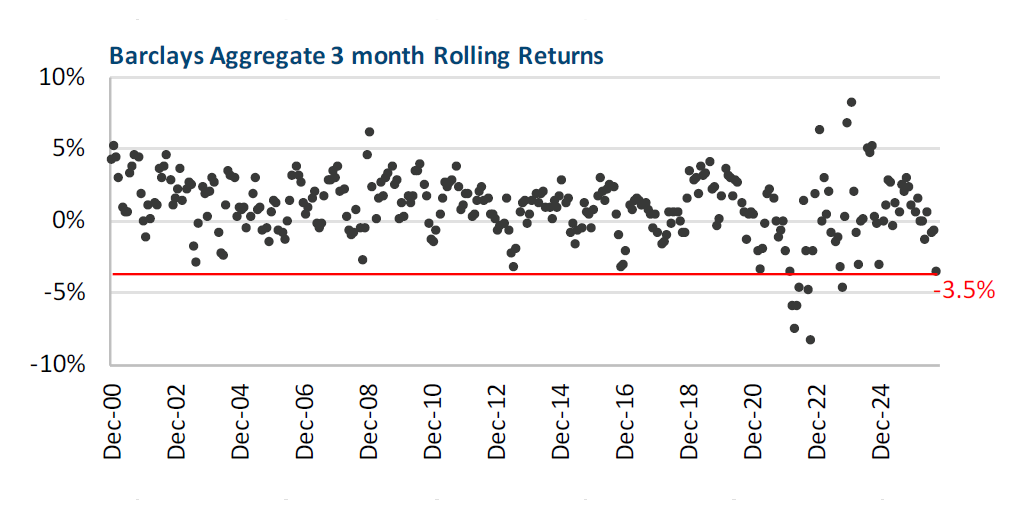
Chart 1
Rising interest rates negatively impact the price of bonds through a metric known as duration. Duration is the expected price move for a 1% change in interest rates. For the Agg, with a duration of 6, the 90 bps rise in yield for the index, from 4.7% to 5.6%, during Q3 precipitated a 5% price decline, partially offset by a quarter’s worth of income of about 1.2% (25% of its 4.7% yield on 6/30), resulting in the overall quarterly total return of -3.5%. The math of duration and returns, though, helps spell out a silver lining for bonds going forward. And this is illustrated in the next chart.
First, there is the very obvious point that the Agg now yields 5.6%, its highest since 2009. We say bonds are the “honest” asset class in the long run, because they say exactly what they are going to do.
What does this mean? If an investor buys a bond with a 5% yield to maturity and holds it to maturity, barring default, the investor will receive 5% per year, even if that bond’s price fluctuates in the interim. For bond funds and bond indices (and the ETF’s that track them), it is slightly more complex, but an investor can generally expect to receive the yield on the fund on the day it is purchased, as long as it is held for the duration on the purchase date.
For example, on 12/31/18, the yield on the Agg was 3.1% with a duration of 7. While the next seven years included the 13% decline in 2022, the worst year in the history of bonds, seven years later on 12/31/25, the Agg had delivered a total return of 14.8%, or 2.1% per year, off its initial yield by only 1%.
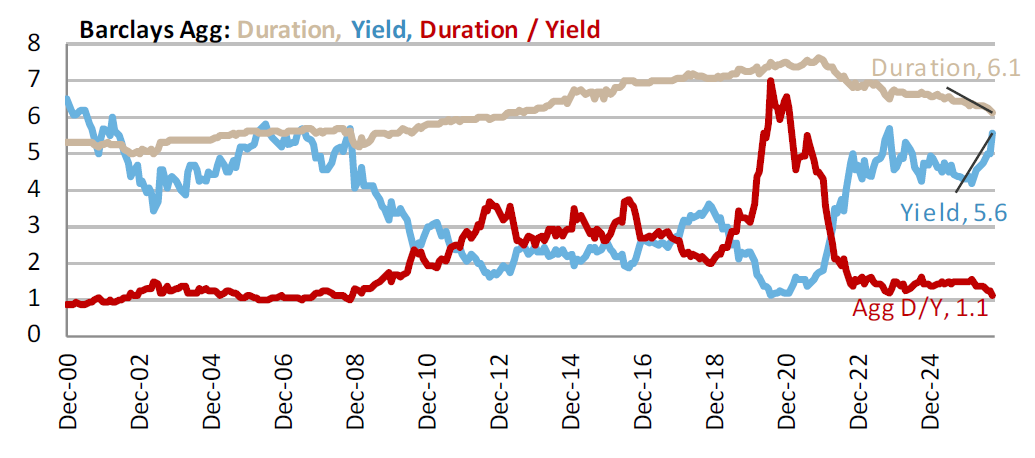
Chart 2
The second reason for investor optimism for bonds is based on duration to yield, or D/Y, which measures interest rate sensitivity to income. This metric was least appealing in 2020, when this ratio reached 7, meaning it would take seven years of 1% income to earn back the 7% price decline if rates rose just 1%.
Looking at Chart 2, thanks to the yield on the Agg reaching its highest since 2009, the D/Y ratio has dropped to 1.1, also the best since 2009, and on par with the pre-GFC ratio between 1 and 1.2. At this level, while you might get short-term losses from interest rates moving, the income being generated can recoup those losses more quickly.
That is why, despite the historically poor -3.5% returns during Q3, as well as the -2.9% year to date returns, since Fixed Income’s Word Is its Bond, the bond market is right now telling us it is offering its BEST return outlook in the past 20 years. While it may require patience through short-term periods of price volatility, the tailwind of the currently high yield should enable bonds to perform their role of delivering steady income.
Entering Q4, it’s not the political race that matters, but the race between interest rates, oil and profits. Going forward, continued profit growth provides a reason to stay optimistic on stocks. Yet one of the biggest concerns, higher interest rates, has made bond yields the most attractive in decades. Thus, it is a reminder to maintain a diverse portfolio, and, if necessary, rebalancing back to target weights is a particularly good idea. Additionally, and ironically, if higher interest rates do prove to be a headwind to economic growth, the most likely outcome is that rates decline, which would benefit bonds, which means they are better able to provide portfolio diversification.