

For many investors, a concentrated stock position is a sign of success. It may come from years of company stock compensation, an early investment in a successful business, founder equity, inherited shares, or ownership in a family company. Over time, one stock can grow into a large share of an investor’s overall wealth.
That success can create a planning challenge. Strong performance may build significant wealth, but having too much tied to one company can also increase risk. If that stock declines sharply, a large portion of the investor’s portfolio and broader financial plan may be affected.
The question is usually not whether the company is good or bad. The better question is whether one position has become too large relative to the investor’s overall goals, liquidity needs, and risk tolerance.
At some point, many investors face an important decision: should they sell shares and diversify, or could there be a better alternative?
Why Selling Is Not Always Simple
The most direct option is to sell shares and reinvest the proceeds into a more diversified portfolio.
Selling can be attractive because it gives the investor immediate liquidity and control. The investor can decide how much to sell, when to sell, and how to reinvest the proceeds. The new portfolio can then be built around income needs, risk tolerance, time horizon, tax considerations, and long-term financial goals.
Diversification can also reduce company-specific risk. If one stock has grown to represent a large portion of net worth, selling part or all of the position may help reduce the impact that any single company can have on the investor’s financial future.
The problem? Taxes.
Many concentrated stock positions have large unrealized capital gains. Selling appreciated shares may create a significant tax bill, especially for investors who have held the stock for many years.
For example, suppose an investor bought stock for $200,000 and the position later grew to $2 million. If they sell the full position, they may owe taxes on the $1.8 million gain. That potential tax cost can make investors hesitant to diversify, even if they understand the risk of holding too much of one stock.
Taxes are not the only factor. Emotional attachment can also play a role. An investor may feel loyal to a company they helped build, or they may worry that selling means missing out on future growth.
Those concerns are understandable. But they should be weighed against the risk of allowing one stock to drive too much of the investor’s financial outcome.
A range of planning strategies can be tailored to address the tax and diversification challenges created by highly appreciated assets. One option that may be appropriate for certain investors is an exchange fund.
What Is an Exchange Fund?
An exchange fund is designed to help eligible investors diversify a concentrated stock position without immediately selling the shares outright.
Rather than selling appreciated stock, investors contribute shares to a pooled investment vehicle. In return, they receive a proportional interest in a more diversified portfolio.
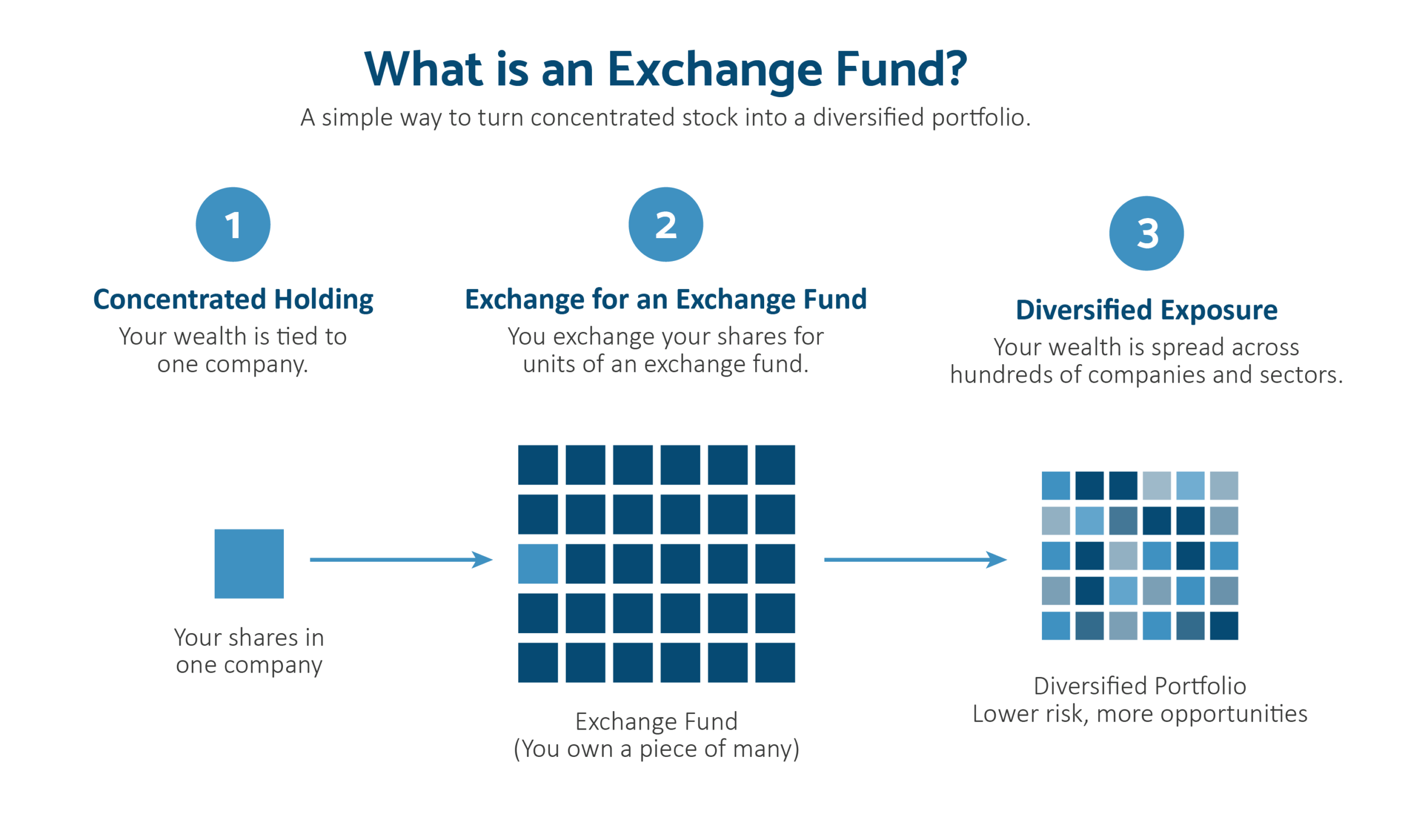
Source: Kitces
Using the earlier example, instead of selling a $2 million stock position and paying taxes immediately, the investor may contribute those shares into an exchange fund alongside other investors with similar concentrated positions. One investor may contribute Apple stock, another may contribute Tesla, and another may contribute Microsoft. Instead of owning only one company, each investor now has exposure to a broader mix of the contributed holdings.
The main potential benefit is tax deferral. Because the investor is contributing shares rather than selling them directly, capital gains taxes can be deferred until a later date.
For investors with highly appreciated stock, this can be appealing. It may allow them to reduce single-company exposure while keeping more capital invested over time.
However, an exchange fund does not eliminate the embedded tax issue. In many cases, it delays when the tax is recognized. The investor’s basis, the fund’s structure, the holding period, and the eventual exit all still matter.
Where the Tradeoffs Actually Sit
Exchange funds may offer benefits, but they are not for everyone, and the decision between selling concentrated stock and using an exchange fund usually isn’t so straightforward.
Selling stock outright is generally simpler. The investor gets cash, pays any taxes due, and can reinvest the proceeds based on their broader financial plan. This approach may be appropriate for investors who value control, need liquidity, or want a clear and immediate reduction in concentration risk.
The downside is the potential tax cost. If the position has a large unrealized gain, selling may reduce the amount available to reinvest after taxes.
An exchange fund may help address that concern by allowing the investor to diversify without immediately triggering the same tax result as an outright sale. For investors with large unrealized gains and a long time horizon, that tax deferral can be meaningful.
But exchange funds come with their own limitations.
One of the biggest tradeoffs is liquidity. Many exchange funds require investors to remain invested for a long period, often seven years or longer. During that time, access to the funds may be limited.
Exchange funds may also involve higher fees, more complex tax reporting, less control over investment decisions, minimum investment requirements, and eligibility standards. Investors also need to understand what they may receive when they eventually exit the fund and how that future exit may be taxed.
The tax treatment of exchange funds is complex and depends on the specific fund structure, holding period, contributed securities, and future redemption or sale. Investors should review these details with their tax and investment advisors before proceeding.
Comparing the Two Approaches
Selling concentrated stock offers clarity and control. The investor knows what is being sold, what taxes may be due, and how the remaining proceeds can be reinvested. It may be the better fit when liquidity is important, when the investor wants full control over the portfolio, or when reducing concentration risk quickly is the priority.
An exchange fund may be more attractive when the investor has a large unrealized gain, does not need near-term liquidity, and is comfortable accepting restrictions in exchange for potential tax deferral. It may reduce exposure to a single stock, but it also limits flexibility and introduces additional complexity.
Neither approach is automatically better. Selling may be more expensive from a tax standpoint, but more flexible. An exchange fund may be more tax-efficient in the near term, but less flexible.
The right decision depends on the investor’s full financial plan.
Key questions include:
- How much of total net worth is tied to this one stock?
- How large is the unrealized gain?
- How much liquidity is needed over the next several years?
- Is the investor comfortable giving up access to the assets for an extended period?
- How important is control over the investment portfolio?
- Would the tax cost of selling materially affect the long-term plan?
- Does the exchange fund’s structure fit the investor’s goals and risk tolerance?
These questions help move the conversation away from a simple “sell or hold” decision and toward a more thoughtful comparison of tax cost, diversification, liquidity, and control.
Looking Ahead
Managing concentrated stock is not just an investment decision. It is a financial planning decision. Reducing risk matters, but so does maintaining flexibility, understanding tax consequences, and making choices that support the investor’s broader goals.
Selling outright may be appropriate for investors who value liquidity, simplicity, and control, even if it creates a tax bill. An exchange fund may be worth considering for eligible investors with significant unrealized gains, longer time horizons, and the ability to accept limited liquidity.
As market values, tax rules, liquidity needs, and family goals evolve, concentrated stock decisions should be revisited with discipline rather than urgency. The objective is not simply to reduce one risk, but to manage concentration, taxes, flexibility, and long-term planning priorities in a coordinated way.
This article is part of an ongoing series aimed to help build overall financial literacy and was authored by Grimes & Company’s 2026 Intern Druv Campanella. While not a comprehensive deep dive into every single topic, it is designed to provide a helpful overview to key topics within the world of investing and financial planning. Please reach out to connect with an advisor or expert on the subject to learn more and start planning for your financial future.
Important Disclosures:
Please remember that past performance is no guarantee of future results. Different types of investments involve varying degrees of risk, and there can be no assurance that the future performance of any specific investment, investment strategy, or product (including the investments and/or investment strategies recommended or undertaken by Grimes & Company Wealth Management, LLC (d/b/a Grimes & Company), or any non-investment related content, made reference to directly or indirectly in this blog will be profitable, equal any corresponding indicated historical performance level(s), be suitable for your portfolio or individual situation, or prove successful. Due to various factors, including changing market conditions and/or applicable laws, the content may no longer be reflective of current opinions or positions. Moreover, you should not assume that any discussion or information contained in this blog serves as the receipt of, or as a substitute for, personalized investment advice from Grimes. To the extent that a reader has any questions regarding the applicability of any specific issue discussed above to his/her individual situation, he/she is encouraged to consult with the professional advisor of his/her choosing. No amount of prior experience or success should be construed that a certain level of results or satisfaction will be achieved if Grimes is engaged, or continues to be engaged, to provide investment advisory services. Grimes is neither a law firm nor a certified public accounting firm and no portion of the blog content should be construed as legal or accounting advice. A copy of the Grimes’ current written disclosure Brochure discussing our advisory services and fees is available for review upon request or at https://www.grimesco.com/form-crs-adv/. Please Note: Grimes does not make any representations or warranties as to the accuracy, timeliness, suitability, completeness, or relevance of any information prepared by any unaffiliated third party, whether linked to Grimes’ web site or blog or incorporated herein, and takes no responsibility for any such content. All such information is provided solely for convenience purposes only and all users thereof should be guided accordingly. Please Remember: If you are a Grimes client, please contact Grimes, in writing, if there are any changes in your personal/financial situation or investment objectives for the purpose of reviewing/evaluating/revising our previous recommendations and/or services, or if you would like to impose, add, or to modify any reasonable restrictions to our investment advisory services. Unless, and until, you notify us, in writing, to the contrary, we shall continue to provide services as we do currently. Please Also Remember to advise us if you have not been receiving account statements (at least quarterly) from the account custodian./