

Many families spend years saving for college, only to discover later that the account was more successful than the education plan required. A scholarship, a lower-cost school, graduate school plans that change, trade programs, military academies, or a child who takes a different path can all leave unused dollars in a 529 plan.
Thanks to a change in the tax code, a newer rule may allow some of those leftover 529 assets to be rolled into a Roth IRA for the beneficiary. The 529 to Roth IRA rollover rule may help families reposition leftover education savings, but it does not turn a 529 plan into a retirement funding vehicle.
This discussion is most relevant for parents, grandparents, and beneficiaries evaluating what to do with unused 529 assets after education expenses have been met.
Why This Matters
529 plans remain one of the most effective tools for education funding. When assets are used for qualified education expenses, they can provide tax-deferred growth and tax-free withdrawals. The challenge comes when the education need is smaller than expected or does not materialize in the way the family originally planned.
Consider a family that saved consistently for a child’s college education and later found that scholarships and school choice left money in the account. The family can preserve the funds for future qualified education expenses, change the beneficiary to another qualifying family member, use limited amounts for student loan repayment, or take a non-qualified withdrawal, which could subject earnings to income tax and penalties.
The 529 to Roth IRA rollover provision now adds another option. If the rules are met, a limited amount of unused 529 assets may be transferred directly to a Roth IRA owned by the 529 beneficiary. This can help move leftover education savings toward long-term retirement savings for the beneficiary.
That is a useful expansion of the planning toolkit, but it should be kept in perspective: the new rule creates a narrow bridge between an education funding vehicle and a retirement savings vehicle when circumstances support it.
It Is a 529 to Roth IRA Rollover, Not a Conversion
The correct term for this transaction is “529 to Roth IRA rollover.” A Roth conversion is a different transaction, when pre-tax retirement assets are generally moved into a Roth account, and income tax may be due in the year of conversion. By contrast, a qualifying 529 to Roth IRA rollover is designed as a direct trustee-to-trustee transfer of eligible 529 assets to the beneficiary’s Roth IRA, subject to specific limits.
Qualifying assets move from the 529 plan to a Roth IRA owned by the 529 beneficiary. They do not move into the Roth IRA of the parent or grandparent who owns the 529 account, unless that person is also the beneficiary.
The potential retirement benefit belongs to the beneficiary, not necessarily the account owner. The rule is not a way to redirect excess education savings into any family member’s retirement account. It is a limited path for the 529 beneficiary, assuming the account, the dollars being transferred, and the beneficiary all meet the required conditions.
The Rules Are Narrow by Design
The new 529 to Roth IRA rollover option is helpful, but Congress did not create an unlimited path from education savings to retirement savings. Several conditions need to line up before unused 529 assets can be moved to a Roth IRA, and those limits help explain why the rule is best viewed as a planning release valve rather than a broad funding strategy.
Key requirements generally include:
The 529 account must satisfy a 15-year rule. The 529 account generally must have been open/maintained for more than 15 years before the 529 to Roth IRA rollover.
Recent contributions are restricted. Contributions made within the prior five years, along with earnings on those contributions, are generally not eligible for a 529 to Roth IRA rollover.
The Roth IRA must belong to the 529 beneficiary. This requirement is central to the rule and limits who can receive the 529 to Roth IRA rollover benefit.
The beneficiary must have earned income. The 529 to Roth IRA rollover is also limited by the beneficiary’s annual IRA eligibility and contribution limit.
Other IRA contributions may reduce available room. If the beneficiary has already contributed to a traditional IRA or Roth IRA for the year, that may reduce the amount available for the 529 to Roth IRA rollover.
There is a $35,000 lifetime cap per beneficiary. That cap may be useful, but it is modest relative to many education savings balances.
Note that 401(k)s and IRAs are not the same thing. They have separate contribution limits and rules and are often confused with one another.
For example, using the 2026 under-age-50 IRA contribution limit of $7,500, and assuming the beneficiary has at least that much earned income and makes no other IRA contributions for the year, if a beneficiary has $35,000 of eligible unused 529 assets, the transfer could occur over five years: $7,500 in each of the first four years and $5,000 in the fifth, assuming sufficient earned income and no other IRA contributions.
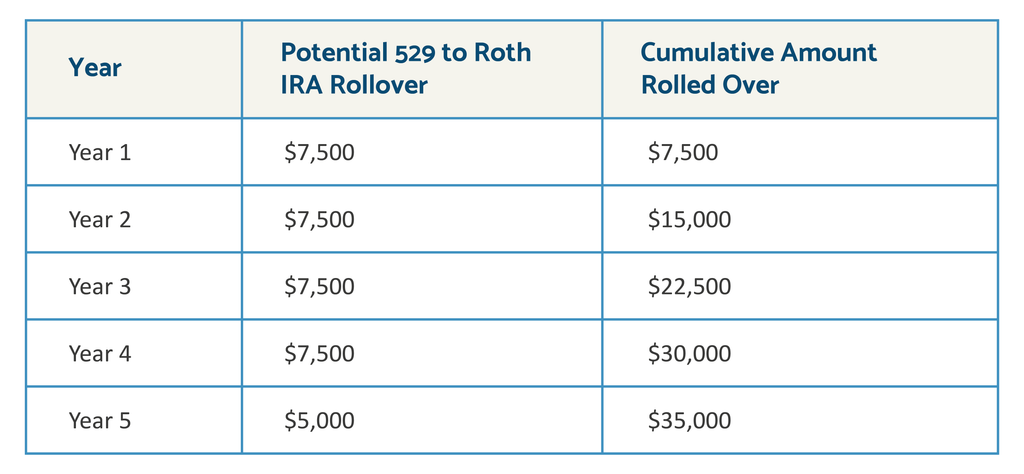
The $35,000 limit is a lifetime cap, not an annual opportunity. Even when a beneficiary has enough eligible unused 529 assets, the 529 to Roth IRA rollover may need to occur gradually over several years. A qualifying 529 to Roth IRA rollover is generally not subject to the regular Roth IRA income limits, but the beneficiary must have earned income, and the 529 to Roth IRA rollover is still limited by the annual IRA contribution limit, reduced by any other IRA contributions made for the year.
Important Questions Still Remain
Although the broad framework is available, several practical questions remain important.
One issue is the treatment of beneficiary changes. Changing a 529 beneficiary can still be useful when one child does not need the funds and another qualifying family member may have future education expenses. However, there is still uncertainty around whether a beneficiary change could reset the 15-year clock for 529 to Roth IRA rollover eligibility. Until additional guidance is clearer, beneficiary changes should be evaluated carefully.
State tax treatment is another consideration. Federal law may allow a qualifying 529 to Roth IRA rollover, but states may not treat the transaction the same way. Some states could require recapture of prior state tax deductions or credits, treat the 529 to Roth IRA rollover as a non-qualified distribution, or impose other state-level consequences. A non-qualified withdrawal generally causes the earnings portion to be taxable and may trigger a 10% additional tax, although exceptions may apply in cases such as scholarships, disability, death, military academy attendance, or certain education-credit coordination situations. Please consult a CPA or qualified tax professional regarding the specific tax implications of any transaction before taking action.
Custodian administration may also vary. Families may need to confirm how a specific 529 provider and Roth IRA custodian will process the transaction, document the age of the account, track contribution history, and report the 529 to Roth IRA rollover.
Planning Implications and Next Steps
For families in this situation, the right question is not simply whether a 529 to Roth IRA rollover is available. It is whether the 529 to Roth IRA rollover fits within the broader education, retirement, tax, and family planning picture.
In some cases, preserving the account for future qualified education expenses or changing the beneficiary may remain more appropriate. In others, a 529 to Roth IRA rollover may provide a useful way to reposition leftover education savings for the beneficiary’s long-term retirement.
At Grimes, we view the 529 to Roth IRA rollover as one planning option to evaluate, not a strategy to pursue in isolation. As guidance, state rules, and family circumstances evolve, these decisions should continue to be evaluated with careful monitoring, measured restraint, and long-term planning discipline.
This article is part of an ongoing series aimed to help build overall financial literacy and was authored by Grimes & Company’s 2026 Intern Jared Peterson. While not a comprehensive deep dive into every single topic, it is designed to provide a helpful overview to key topics within the world of investing and financial planning. Please reach out to connect with an advisor or expert on the subject to learn more and start planning for your financial future.
Important Disclosures:
Please remember that past performance is no guarantee of future results. Different types of investments involve varying degrees of risk, and there can be no assurance that the future performance of any specific investment, investment strategy, or product (including the investments and/or investment strategies recommended or undertaken by Grimes & Company Wealth Management, LLC (d/b/a Grimes & Company), or any non-investment related content, made reference to directly or indirectly in this blog will be profitable, equal any corresponding indicated historical performance level(s), be suitable for your portfolio or individual situation, or prove successful. Due to various factors, including changing market conditions and/or applicable laws, the content may no longer be reflective of current opinions or positions. Moreover, you should not assume that any discussion or information contained in this blog serves as the receipt of, or as a substitute for, personalized investment advice from Grimes. To the extent that a reader has any questions regarding the applicability of any specific issue discussed above to his/her individual situation, he/she is encouraged to consult with the professional advisor of his/her choosing. No amount of prior experience or success should be construed that a certain level of results or satisfaction will be achieved if Grimes is engaged, or continues to be engaged, to provide investment advisory services. Grimes is neither a law firm nor a certified public accounting firm and no portion of the blog content should be construed as legal or accounting advice. A copy of the Grimes’ current written disclosure Brochure discussing our advisory services and fees is available for review upon request or at https://www.grimesco.com/form-crs-adv/. Please Note: Grimes does not make any representations or warranties as to the accuracy, timeliness, suitability, completeness, or relevance of any information prepared by any unaffiliated third party, whether linked to Grimes’ web site or blog or incorporated herein, and takes no responsibility for any such content. All such information is provided solely for convenience purposes only and all users thereof should be guided accordingly. Please Remember: If you are a Grimes client, please contact Grimes, in writing, if there are any changes in your personal/financial situation or investment objectives for the purpose of reviewing/evaluating/revising our previous recommendations and/or services, or if you would like to impose, add, or to modify any reasonable restrictions to our investment advisory services. Unless, and until, you notify us, in writing, to the contrary, we shall continue to provide services as we do currently. Please Also Remember to advise us if you have not been receiving account statements (at least quarterly) from the account custodian./