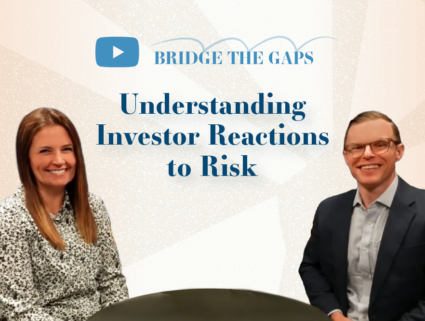


Market volatility can cause even experienced investors to question their investment strategy. As part of the Risk Gap, Janelle Coulman and Tom Dunlap discuss investor reactions to risk, the challenges of market timing, and the importance of staying focused on long-term financial goals.
From holding too much cash to balancing growth and risk tolerance, Janelle and Tom explore how financial planning and portfolio management can help investors navigate uncertain markets, manage risk, and make thoughtful investment decisions.
Video Transcript
Janelle Coulman: Hello, my name is Janelle Coulman, and I’m a Financial Advisor at Grimes & Company. Today, I’m here with Tom Dunlap, a Senior Investment Analyst at the firm, to discuss investor reactions to risk.
We often hear from clients that investing feels manageable when markets are calm, but much harder when headlines turn negative and account values begin to move. We can all agree that investor concern is very reasonable during volatile periods. Even experienced investors sometimes feel the urge to take action when there’s a bout of volatility. I think the purpose of our conversation today isn’t to eliminate concern, but rather to make risk feel more manageable.
When people hear the word “risk,” they often associate it with losing money. From an investment perspective, do you think that’s a good definition?
Tom Dunlap: Capital impairment is certainly a risk, and perhaps a key risk used in a lot of textbooks and similar definitions. But as we know from working with our clients, risk takes many shapes and forms. It can be the risk of missing out on an opportunity, the risk of not taking enough risk, illiquidity risk, and certainly volatility as well.
Janelle: Right. And I find that investors often focus on a risk they can immediately see, such as a market decline that’s present on their monthly statement. But the reality is that risks we can easily see aren’t always the ones that have the biggest impact on the long-term success of their plan. Sometimes, the greatest risk can be avoiding today’s discomfort at the expense of tomorrow’s opportunities.
Tom: Absolutely. And that’s where volatility comes in. It’s not necessarily a bad thing in and of itself, but it’s the volatility that’s above and beyond what’s appropriate for the client that we need to manage, adjusting the portfolio accordingly.
A lot of times, what happens with volatility is that it opens the door to other biases and emotions that can get in the way of good decision-making.
Janelle: One of the most common concerns we hear is, “The market is down, so is my portfolio. Does that mean something’s wrong with my strategy?” How would you help someone think through that?
Tom: It’s a very common question. Usually, the answer is that markets do tend to go up over time. It’s about having a plan and an investment portfolio that reflects that plan. Keeping things grounded in long-term objectives can help investors think through and work through the feelings that market declines can present.
It’s interesting that a large portion of stock market returns comes from a very small percentage of days, and missing out on these few days can dramatically change the trajectory of a pool of assets.
It’s really important to stay invested and have a portfolio that’s based on a financial plan with a long-term objective. That enables clients to withstand volatility, particularly on the downside, so those positive days can be captured. Those positive days happen in both down markets and up markets, so being invested throughout the cycle is critical.
Janelle: Right. And I think more so than taking action, a client often just wants some reassurance that their concerns are valid. The advisor’s role is certainly not to dismiss that emotion or eliminate risk entirely, but to help investors separate their emotions from action.
Tom: Absolutely. The holy grail in everything we do from a portfolio construction standpoint is determining how we meet a long-term objective with the least amount of risk.
Risk is usually defined as volatility, and finding that right combination and making sure there’s not unnecessary or excess risk is really important.
Janelle: Right. And when clients are feeling uncomfortable, I think that’s a good opportunity to review the plan, but it doesn’t always necessarily mean the plan needs to change.
Tom: Absolutely.
Janelle: When markets fall, selling can feel like a way for investors to regain control. Why do you think this reaction is so difficult in practice?
Tom: I think it’s when emotion really starts to drive the bus, as opposed to the long-term goal. That’s where it can be important for everyone to get together, reset expectations, and really understand that the investment program is a reflection of the financial plan and that they’re working in tandem.
Janelle: Right. And so when markets are down, certainly that can often cause a reaction. But another variation of market timing is how some investors can be overly cautious when markets are good.
Tom: Yes, and it is counterintuitive, but actually investing at all-time highs can be more beneficial to long-term results. J.P. Morgan has done a study on this, and investing at all-time highs actually produces better results over three- and five-year periods than investing on any random day.
I think if you take a step back and really think about why that might be the case, usually when a market is making an all-time high, it’s because the market environment is supportive, whether it’s earnings, technicals, valuations, fiscal policy, or monetary policy.
That support isn’t always fleeting. It’s usually there for months or quarters at a time. So it can give some people confidence that although markets are strong, it’s not necessarily a reason to sit and wait. It’s really more important to be invested for longer than it is to be invested at a certain point in time.
Janelle: Right. So fear may drive someone to sell, and then that relief keeps them out of the market for some period of time. A big risk is that by the time confidence resurfaces, the markets may have already rebounded.
The challenge isn’t only predicting the market, but also predicting how we might feel later.
Tom: And that’s really where I think you can start to draw the line between an investment plan and speculation. Having a long-term plan that’s based on economic reasoning and financial plans and goals is easier to stick to, as opposed to trying to get the timing just right and hoping that you nail it.
Janelle: For investors who are especially uncomfortable with volatility, holding more cash can feel safe. What trade-offs might come with that?
Tom: It’s a very important trade-off to understand. Everyone has a level of cash that gives them comfort, and everyone also has a level of cash that makes sense from a long-term investment standpoint. A lot of times, the right answer is somewhere in the middle.
Cash can be a great tool for dampening volatility, but it tends to lose purchasing power when inflation is high. It tends to weigh on results when markets are strong. So there certainly are risks to holding too much cash, well above and beyond what actually provides the comfort and security that some people might need.
Janelle: Yeah, and I think the conversation isn’t about taking risk just to take risk. Money needed for a home next year has a different job than money needed for retirement 20 years from now. It’s about making sure each dollar is invested in a way that’s appropriate for when the investor needs to spend it.
Tom: Absolutely.
Janelle: It’s so important that the investment side and the planning side of the firm work together when determining an appropriate level of risk for a client. What common considerations are given on the investment side?
Tom: Well, first and foremost is liquidity. We need to make sure any near-term liquidity needs are going to be met, whether that’s holding cash, short-term bonds, or something else in that neighborhood.
Then it’s also making sure that we have enough growth in the portfolio to keep things growing along with goals and objectives. Usually, that’s well above and beyond inflation as the first consideration. Then it’s what growth is needed to help make a financial plan come together over the long haul.
On the other side of that, it’s adjusting and calibrating for risk tolerance. Not everyone has the same risk tolerance, even if they have similar long-term return objectives.
It’s making sure that there’s not unnecessary risk, and that the risk that’s in a portfolio is something we know and understand and are able to provide some guardrails around.
Janelle: Right. And the terrific work done on the investment side really helps an advisor work with the client on focusing on their goals, making sure they make sense and are understood by everyone involved.
Obviously, an understanding of the time horizon, when money might be needed, and their income needs is important. And as you mentioned, also just the general comfort with market movement, so that investors feel comfortable remaining invested and sticking to their plan.
A client’s comfort with risk will change over time, and that’s why I think it’s very important to keep communication open and ongoing.
Confidence in investing does not mean feeling calm every time the market moves. It means understanding what your money is for and being thoughtful before taking action.
Consider reviewing the purpose and time horizon for each portion of your portfolio with your investment advisor. That may make it easier to tell the difference between short-term market noise and a change that truly deserves some attention.
Thank you for watching, and please visit Grimesco.com for more information.
Important Disclosures:
Past performance is not indicative of future results. Different types of investments involve varying degrees of risk. Therefore, there can be no assurance that the future performance of any specific investment or investment strategy (including the investments and/or investment strategies recommended and/or undertaken by Grimes & Company Wealth Management, LLC [“Grimes”]), or any non-investment related content, made reference to directly or indirectly in this blog will be profitable, equal any corresponding indicated historical performance level(s), be suitable for your portfolio or individual situation, or prove successful. Due to various factors, including changing market conditions and/or applicable laws, the content in this blog may no longer be reflective of current opinions or positions. Moreover, you should not assume that any discussion or information contained in this blog serves as the receipt of, or as a substitute for, personalized investment advice from Grimes. To the extent that a reader has any questions regarding the applicability of any specific issue discussed above to his/her individual situation, he/she is encouraged to consult with the professional advisor of his/her choosing. No amount of prior experience or success should be construed that a certain level of results or satisfaction will be achieved if Grimes is engaged, or continues to be engaged, to provide investment advisory services. Grimes is not a law firm and does not provide legal advice. Grimes is not a certified public accounting firm. Grimes is affiliated with S&C Tax Advisors, which provides tax preparation and related tax services. Tax services provided by S&C Tax Advisors are separate and distinct from the investment advisory services provided by Grimes and are subject to a separate engagement. Clients are under no obligation to engage S&C Tax Advisors and may obtain tax preparation or other tax services from any provider of their choosing. Information provided by Grimes regarding tax matters in connection with its investment advisory services should not be construed as individualized tax advice or a substitute for services provided by a qualified tax professional. Grimes is not an insurance agent. Grimes Representatives may, however, separately provide insurance products and services through our affiliate, Grimes Wealth Protection Group, LLC. If the client desires, one of Grimes’ representatives, acting in their capacity as a representative of Grimes Wealth Protection Group, LLC or in their separate licensed individual capacities, can be engaged to provide insurance sales/services as described on Grimes’ written disclosure Brochure per the terms and conditions of a separate engagement. Grimes is affiliated with Grimes Trust Services, a corporate trustee that offers trustee services under a separate engagement. Clients are under no obligation to retain Grimes Trust Services for trustee services. Any information provided by Grimes regarding trust matters in connection with its investment advisory services should not constitute trustee services and be considered a substitute for services provided by a qualified professional. Nothing contained herein should be construed as the receipt of, or a substitute for, personalized investment advice from Grimes. A copy of our current written disclosure Brochure discussing our advisory services and fees is available for review upon request or athttps://www.grimesco.com/form-crs-adv/ Please Note: Grimes does not make any representations or warranties as to the accuracy, timeliness, suitability, completeness, or relevance of any information prepared by any unaffiliated third party, whether linked to Grimes’ web site or blog or incorporated herein, and takes no responsibility for any such content. All such information is provided solely for convenience purposes only and all users thereof should be guided accordingly. Please Remember: If you are a Grimes client, please contact Grimes, in writing, if there are any changes in your personal/financial situation or investment objectives for the purpose of reviewing/evaluating/revising our previous recommendations and/or services, or if you would like to impose, add, or to modify any reasonable restrictions to our investment advisory services. Unless, and until, you notify us, in writing, to the contrary, we shall continue to provide services as we do currently. Please Also Remember to advise us if you have not been receiving account statements (at least quarterly) from the account custodian.