
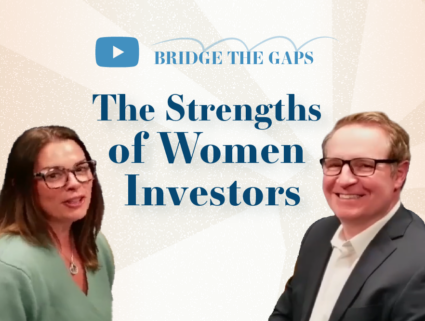
With women expected to control $34 trillion in assets by 2030, their role in the financial landscape continues to grow—yet gaps in confidence still remain. In this video, Executive Vice President Emily Wood sits down with Chief Investment Officer Matt Morse to explore how women investors are closing that gap and, in many cases, outperforming over time.
From the power of compounding to the importance of staying invested through market volatility, Emily and Matt share practical insights to help investors build confidence and take a long-term approach. Watch the full conversation below to learn how starting early and staying disciplined can make a meaningful difference.
Video Transcription:
Emily Wood:
Here at Grimes and Company, our mission is to provide financial peace of mind through today’s evolving financial landscape. And our conversation today is going to highlight the importance of supporting women through this. Women expected to control $34 trillion in assets by 2030, while still facing gaps in things like pay, confidence, and financial access.
For us, it’s not just about addressing those gaps. It’s about resolving them. I’ve asked Matt Morse, our Chief Investment Officer here at Grimes and Company to join me this morning to talk a little bit about this. And so I’m to put Matt on the spot to start and ask him to share an anecdote he told me last week about how he started investing.
Matt Morse:
Sure. Thanks, Emily. Great to be here.
Yeah, this this topic is near and dear to me. The person who piqued my interest in investing was my grandmother, who lived to be almost 102 years of age.
When I was in high school, she suggested that I begin reading the Wall Street Journal, the business section of the newspaper and learn as much as I could about investing. She’d done pretty well for herself in the stock market. And needless to say, here I am still enjoying it all these years later.
Emily Wood:
That’s fantastic. I love that story. Your grandmother was definitely a pioneer, but she’d be thrilled to know that there are more and more women entering the market.
And so today what I wanted to talk to you about, and get your investment perspective on, is really this confidence gap that we perceive, and the investment gaps.
So where we’re seeing more women investing, we want to make sure that they have the confidence in their decisions and the investment knowledge that they need to succeed.
And when it comes to investing, there’s actually multiple studies. These include things from Fidelity and Vanguard that show that over time, women investors tend to do about one half to 1% better than their male investor counterparts annually.
So this obviously doesn’t sound like much, but it could certainly add up when compounded over time.
Matt Morse:
Yeah, it’s a really important point. And this confidence gap is, that you mentioned, can actually help a lot. You know, 1% or so a year doesn’t sound like a big number. But in fact, as shown on our power of compounding chart.
If we look out over 20 years and just as an example a million dollars invested on day one for a portfolio that does 7% a year versus a portfolio that does 8% a year, over those 20 years that 1% difference, which again doesn’t sound like a lot, on that million dollars an investor at the end of 20 years would have an additional eight hundred thousand dollars.
So, an extra eight hundred thousand on a million dollar initial investment speaks to why Einstein called compound interest the eighth wonder of the world and in this case it’s $800,000 wonder for the patient investor with the extra 1%.
Emily Wood:
Yeah, and I think part of that is women, I think they trade a little bit less. And so well, it’s certainly important to trade enough, you know, if you have a significant liquidity need coming up, we certainly don’t want to see all of your assets in the stock market.
But higher trading volume can lead to higher costs over time, and ultimately some some poor timing decisions, which I think is something we spend a lot of time talking about here. Can you talk a little bit more about that, Matt?
Matt Morse:
Yeah, sure. It’s a great point. And I’ll chat about this chart here. And what we see here is really going back to 1980, the annual average annual decline for the S &P 500 by year and the average annual return.
I think, you know, takeaway number one from this is that volatility is a very real aspect of investing in the stock market. It’s inevitable and unavoidable. In fact, the S&P has declined about 14 % on average each year. So, you know, real volatility, and that’s an average. But importantly, over those same 45 years, the return on the S&P 500 has been 11 % per year.
It’s been positive about 75% of the time. So, really the key lesson is to establish a long-term plan and stick with it and not be reactionary to the inevitable volatility, because it can really make a difference in over your long-term returns.
Emily Wood:
Other studies have shown that women are more patient investors, and they are less likely to react to that short-term volatility that you were just referring to.
I just think of these last six years, so since COVID, there’s been no shortage of volatility. We got through COVID, then we had tariffs, now we have the Iran War. And investors who react to these things in real time, typically they end up behind.
Matt Morse:
Yes, and you know, brings us back to the point of to really benefit from investing in the market, you have to stay invested.
Emily, you mentioned the last six years and all that’s happened. even if we zoom out to the past 20 years, which includes the global financial crisis, COVID, several major geopolitical events, ⁓ surge in inflation and much more, despite all of these ⁓ challenging periods for the economy in the market, the S&P is up 700 % over these two decades for about an 11 % annual return.
So I’d say point one, an investor who simply invested 20 years ago and stayed invested would have enjoyed the 700 % or 11 % annualized returns. However, to your point on, you know, investors that might get skittish during pullbacks and so forth, if an investor would have missed just the best 10 days out of 20 years, their return declines to a 6.6 % return as opposed to 11. So a huge difference, almost half.
Missing the best 20 days, again, out of 20 years, the return drops to less than 4 % per year versus 11 for one who stayed invested. And then amazingly, if you miss the best 60 days, the return for that investor would be negative 3 % versus plus 11.
So we’re talking matters of days of being out of the market out of a 20 year period. And the difference in returns of plus 11 % versus minus three really drives home the point of having that long-term plan and sticking with it, particularly when the market is volatile.
And a recent example is almost a year ago to the day when we had the pause on tariffs, the S&P 500 was up 9 % in a single day. And often what we see, whether it was March and April of 2020 during COVID, a lot of these sort of best days of the year for the market come in small bunches. And that’s why it’s so important to stay invested for the long-term.
Emily Wood:
Yeah, those statistics always amaze me.
Another, you know, speaking of time in the market, you know, there’s something to be said for for starting early, it is much better to start investing earlier. And you know, we can’t overstate enough that getting into the market early with a smaller amount is much better than waiting until later on in your career and trying to save more.
Matt Morse:
You know, this is even more of a consideration for women who tend to live longer than men. So, you know, planning for a longer retirement, starting earlier, staying invested, can’t, as Emily said, really can’t overstate the importance of starting early.
Emily Wood:
And your grandmother is the perfect example. She lived till 102. And She had a great retirement.
So I could talk about these things all day and I know we just barely scratched the surface, but I think for today, the takeaway would be start early. Even if it’s a small dollar figure, you want to start investing early.
You want to stay invested through the volatile patches, recognizing that volatility can be your friend.And you want to let the power of compounding work for you by, again, starting early, staying disciplined, and seeing your money grow over time. So thanks for joining me.
I know you are busy, but this was a great chat, and I look forward to having more in the future.
Matt Morse:
Thanks for having me. Great to be here. Take care.
Important Disclosures:
Please remember that past performance is no guarantee of future results. Different types of investments involve varying degrees of risk, and there can be no assurance that the future performance of any specific investment, investment strategy, or product (including the investments and/or investment strategies recommended or undertaken by Grimes & Company Wealth Management, LLC (d/b/a Grimes & Company), or any non-investment related content, made reference to directly or indirectly in this blog will be profitable, equal any corresponding indicated historical performance level(s), be suitable for your portfolio or individual situation, or prove successful. Due to various factors, including changing market conditions and/or applicable laws, the content may no longer be reflective of current opinions or positions. Moreover, you should not assume that any discussion or information contained in this blog serves as the receipt of, or as a substitute for, personalized investment advice from Grimes. To the extent that a reader has any questions regarding the applicability of any specific issue discussed above to his/her individual situation, he/she is encouraged to consult with the professional advisor of his/her choosing. No amount of prior experience or success should be construed that a certain level of results or satisfaction will be achieved if Grimes is engaged, or continues to be engaged, to provide investment advisory services. Grimes is neither a law firm nor a certified public accounting firm and no portion of the blog content should be construed as legal or accounting advice. A copy of the Grimes’ current written disclosure Brochure discussing our advisory services and fees is available for review upon request or at https://www.grimesco.com/form-crs-adv/. Please Note: Grimes does not make any representations or warranties as to the accuracy, timeliness, suitability, completeness, or relevance of any information prepared by any unaffiliated third party, whether linked to Grimes’ web site or blog or incorporated herein, and takes no responsibility for any such content. All such information is provided solely for convenience purposes only and all users thereof should be guided accordingly. Please Remember: If you are a Grimes client, please contact Grimes, in writing, if there are any changes in your personal/financial situation or investment objectives for the purpose of reviewing/evaluating/revising our previous recommendations and/or services, or if you would like to impose, add, or to modify any reasonable restrictions to our investment advisory services. Unless, and until, you notify us, in writing, to the contrary, we shall continue to provide services as we do currently. Please Also Remember to advise us if you have not been receiving account statements (at least quarterly) from the account custodian./