
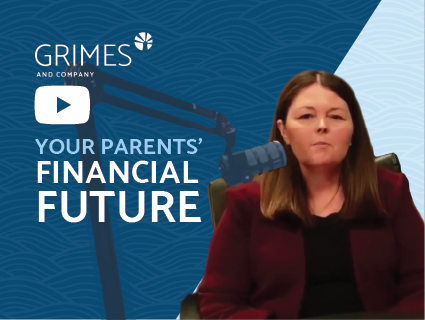

Preparing for the future isn’t just about your own financial plan—it’s also about understanding how aging parents and loved ones may fit into it. Many families are surprised by how quickly health changes or unexpected events can create emotional and financial stress. Having open, thoughtful conversations ahead of time can provide clarity, protect independence, and help families respond more confidently when the unexpected happens. In this video, Grimes & Company Financial Advisor Patty Lavoie discusses how to start the conversation, what information families should have in place, and how working together as a team can help ensure your parents’ goals and wishes are supported.
Watch the video and view the full transcript below:
Watch Other Videos in this Series
- The Basics of Setting a Budget
- Understanding RMDs
- How Much Risk Should You Take in Pre-Retirement?
- What Are Emergency Funds?
- What Is a Glide Path?
- Inflation & Retirement
- The Power of Compound Interest
- Maximize Your Retirement Plans: 401(k), IRA, HSA
Video Transcription:
My name is Patty Lavoie and I’m a financial advisor at Grimes & Company. Today’s discussion topic is preparing for your parents’ financial future. Having worked with many clients over the years, the number one concern, regardless of net worth, is will I have enough to take care of myself and my family in the way that I want to? Often when we think of a family, we think of our spouse and children.
But have you ever contemplated what might happen if you had to provide financial support for a parent or other family member? Increasingly across our client we are seeing adult children have to step up and provide care and financial support for their aging parents. So why does this conversation matter?
The most important reason is clarity. Understanding if your parents or family members’ financial resources can support their goals and wishes during their retirement years is essential.
Having navigated an Alzheimer’s diagnosis with my own father, I know these situations can create emotional and financial stress for both the individual and the caregivers. So having a tentative plan in place can make a big difference if something unexpected happens and decisions need made quickly in a crisis.
That said, starting these conversations is not easy. You definitely want to find the right time and lead with care, not control.
Sometimes this conversation develops organically due to a sudden health issue or the unexpected loss of a family member or friend.
Other times you have to be more creative. One option might be to let them know that you’re working on your own planning and ask them when the last time it was that they reviewed their plan and if they still feel good about what they have in place.
The key to all of this is to listen more than you talk. If you have concerns or think they may need additional support to meet their goals, you can work together as a team to address those issues so neither of you is left feeling financially compromised.
Obviously covering all these topics may take multiple conversations and in many cases should include meetings with their attorney, their financial advisor, or other professionals. At Grimes we encourage family meetings and are happy to help facilitate those conversations with our clients. And then from a very practical standpoint there are a few items that you want to be sure you have in place.
The first is to confirm that their estate plan is up to date and that you know where to find those documents. Generally, estate plans should be reviewed every five years and at minimum include will, power of attorney, and health care directives. Also, you want to know where to find recent copies of their financial statements and their insurance policies. And perhaps most importantly, you want to have a good list of their emergency contacts. And that’s going to include their attorney, their tax professional, their doctors, and of course, their financial advisor.
If you haven’t had these conversations yet, feel free to reach out to your own advisor for guidance on how to broach this topic and what questions to ask. A small conversation today can make a big difference.
Important Disclosures:
This presentation is intended for general information purposes only. No portion of the presentation serves as the receipt of, or as a substitute for, personalized investment advice from Grimes & Company Wealth Management, LLC (d/b/a Grimes & Company) (“Grimes”) or any other investment professional of your choosing. Different types of investments involve varying degrees of risk, and it should not be assumed that future performance of any specific investment or investment strategy, or any non-investment related or planning services, discussion or content, will be profitable, be suitable for your portfolio or individual situation, or prove successful. Neither Grimes’ investment adviser registration status, nor any amount of prior experience or success, should be construed that a certain level of results or satisfaction will be achieved if Grimes is engaged, or continues to be engaged, to provide investment advisory services. Grimes is neither a law firm nor accounting firm, and no portion of its services should be construed as legal or accounting advice. No portion of the video content should be construed by a client or prospective client as a guarantee that he/she will experience a certain level of results if Grimes is engaged, or continues to be engaged, to provide investment advisory services. Copies of Grimes’ current written disclosure Brochure and Form CRS discussing our advisory services and fees are available upon request or at www.grimesco.com.