

Bonds may provide income and help reduce some of the ups and downs that can come with investing. They can be especially useful for investors who want a steadier approach or who are looking for ways to support future income needs.
However, not all bonds work the same way. Their maturity, tax treatment, and level of risk can all affect how they fit into a financial plan. Understanding a few basic differences can make it easier to choose the types of bonds that best match your goals, time horizon, and comfort level.
Understanding Bond Maturities
A bond’s maturity is the date when the issuer is expected to repay the amount borrowed. Bonds are commonly grouped by how long they have until maturity.
Short-Term Bonds: 1 to 3 Years
Short-term bonds generally mature within one to three years. They are often used for stability, liquidity, and income needs that may arise in the near future. Because their maturity dates are relatively close, short-term bonds tend to be less sensitive to changes in interest rates. However, they also typically offer lower yields than longer-term bonds.
Intermediate-Term Bonds: 4 to 10 Years
Intermediate-term bonds generally mature within four to ten years. For many investors, they serve as the core of a bond allocation because they may offer a reasonable balance between income potential and price stability. Typically, they provide more income than short-term bonds while carrying less interest-rate sensitivity than long-term bonds.
Long-Term Bonds: 10 Years and Longer
Long-term bonds generally mature more than 10 years from the date they are issued. They may offer higher yields, but they are also more sensitive to interest-rate changes. When market interest rates rise, long-term bond prices can experience larger declines. When rates fall, long-term bonds may experience greater price appreciation. This additional sensitivity can create more significant price swings than investors may expect from a bond investment.
For many investors, an effective approach is not to select only one maturity range. Blending short-, intermediate-, and long-term bonds can help create a balance between liquidity, income, and long-term return potential.
Ways to Invest in Bonds
Investors can purchase individual bonds or gain bond exposure by using a basket of bonds, such as a mutual fund or exchange-traded fund. Each approach has different advantages and considerations.
Individual Bonds
An individual bond has a stated maturity date. Assuming the issuer does not default, the investor generally receives interest payments during the bond’s term and the bond’s principal value when it matures. They may provide greater predictability when purchased with the intention of holding them until maturity. However, their value can still fluctuate before maturity. An investor who sells a bond early may receive more or less than the original purchase price.
Building a diversified portfolio of individual bonds may also require a larger investment and more ongoing oversight.
ETFs and Mutual funds
Mutual Funds and Exchange Traded Funds (ETF’s) are pooled investments that hold a portfolio of bonds. Many are actively managed while others simply track an index. They can be bought and sold on a daily basis. Unlike an individual bond, a bond mutual fund or ETF does not typically have a maturity date on which an investor’s original principal is automatically returned. Its share price will continue to fluctuate as interest rates, credit conditions, and the underlying portfolio change. Bond funds and ETFs can still provide valuable income and diversification, but investors should not expect them to behave exactly like an individual bond held to maturity.
Tax Treatment Can Differ by Bond Type
The income produced by bonds can receive different tax treatment depending on the type of bond, the account in which it is held, and the investor’s individual tax situation.
Taxable Bonds
Taxable bonds include U.S Treasury bonds, federal agency bonds, and corporate bonds. Interest in these investments is generally subject to federal income tax. Corporate and agency bonds may also be subject to state and local income taxes. Interest from U.S. Treasury securities is generally exempt from state and local income taxes but remains subject to federal income tax.
Because taxable bonds can generate ongoing taxable income, they may sometimes be appropriate for tax-deferred accounts such as traditional IRAs and 401(k)s. Within these accounts, interest can generally grow tax-deferred until money is withdrawn.
For example, a corporate bond held in a traditional IRA may generate interest without creating a current annual tax obligation. However, distributions from the account are generally taxed as ordinary income (read our recently published Asset Location article for more information).
Municipal Bonds
Municipal bonds are issued by states, cities, counties, and other governmental entities. Their interest is often exempt from federal income tax. It may also be exempt from state or local income tax when the investor lives in the state where the bond was issued.
Municipal bonds may therefore be attractive to investors in higher tax brackets, particularly when they are held in taxable accounts. However, a municipal bond’s stated yield should not be compared directly with the yield of a taxable bond. Investors may instead calculate a tax-equivalent yield, which estimates the taxable return needed to equal the after-tax income of a municipal bond.
Choosing between taxable and municipal bonds requires consideration of the investor’s income, tax bracket, state of residence, account type, and the credit quality of the available bonds. In some cases, using both may help create a more tax-efficient income strategy across different accounts.
Understanding the Risk in Bonds
Interest rate risk is the risk that a bond’s value will fall as interest rates rise. This is how bond markets compensate investors for constantly adjusting yields. If interest rates are moving up, the value of a bond with a lower rate is worth less.
Inflation risk is more common in long-term bonds, losing the purchasing power of your investment due to inflation eroding the value of the cash flows.
Some investors also worry about the liquidity portion of bonds since they are only available to receive their money when bonds are held to maturity.
Not all bonds carry the same level of default risk. U.S. Treasuries are generally considered among the highest-quality bonds, while corporate and high-yield bonds carry more credit risk. Higher yields often reflect higher risk, so investors should evaluate whether the extra income is worth the added uncertainty.
What Is a Bond Ladder?
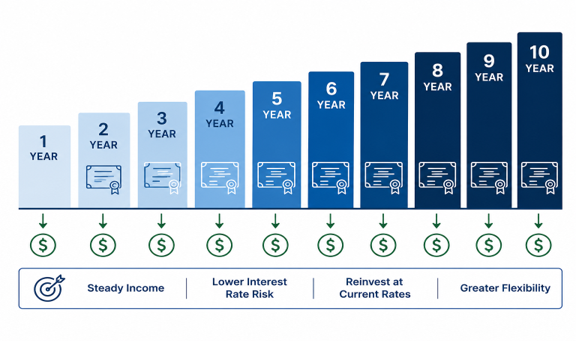
A bond ladder combines both structure and flexibility. By holding bonds that mature at staggered intervals, such as every year from one to 10 years, you can:
- Maintain consistent income and reinvest maturing bonds at current rates
- Reduce reinvestment and interest rate risk
- Blend taxable and municipal bonds for better after-tax efficiency
Over time, a ladder can help keep your portfolio balanced and responsive without the need to predict where rates are headed.
Thinking Strategically
A thoughtful bond strategy is not about selecting a single maturity, bond type, or variation. It is about building the right mix of bonds, along with taxable or municipal bonds and individual bonds or funds, to match your goals, time horizon, and tax picture.
Whether built through a ladder, a managed fund, or a combination of both, a well-structured diversification can help provide income, stability, and flexibility as part of your broader financial plan.
Read previous “Bond 101” Articles:
- What is a Bond? A 101 Overview
- What Are Treasuries, Municipals, and Corporates? Bond Types Explained
- Mutual Funds vs. ETFs: What They Are and How They Differ
- Tax-Free Income: Should You Consider Municipal Bonds?
This article is part of an ongoing series aimed to help build overall financial literacy and was authored by Grimes & Company’s 2026 Intern Carter Richardson. While not a comprehensive deep dive into every single topic, it is designed to provide a helpful overview to key topics within the world of investing and financial planning. Please reach out to connect with an advisor or expert on the subject to learn more and start planning for your financial future.
Important Disclosures:
Past performance is not indicative of future results. Different types of investments involve varying degrees of risk. Therefore, there can be no assurance that the future performance of any specific investment or investment strategy (including the investments and/or investment strategies recommended and/or undertaken by Grimes & Company Wealth Management, LLC [“Grimes”]), or any non-investment related content, made reference to directly or indirectly in this blog will be profitable, equal any corresponding indicated historical performance level(s), be suitable for your portfolio or individual situation, or prove successful. Due to various factors, including changing market conditions and/or applicable laws, the content in this blog may no longer be reflective of current opinions or positions. Moreover, you should not assume that any discussion or information contained in this blog serves as the receipt of, or as a substitute for, personalized investment advice from Grimes. To the extent that a reader has any questions regarding the applicability of any specific issue discussed above to his/her individual situation, he/she is encouraged to consult with the professional advisor of his/her choosing. No amount of prior experience or success should be construed that a certain level of results or satisfaction will be achieved if Grimes is engaged, or continues to be engaged, to provide investment advisory services. Grimes is not a law firm and does not provide legal advice. Grimes is not a certified public accounting firm. Grimes is affiliated with S&C Tax Advisors, which provides tax preparation and related tax services. Tax services provided by S&C Tax Advisors are separate and distinct from the investment advisory services provided by Grimes and are subject to a separate engagement. Clients are under no obligation to engage S&C Tax Advisors and may obtain tax preparation or other tax services from any provider of their choosing. Information provided by Grimes regarding tax matters in connection with its investment advisory services should not be construed as individualized tax advice or a substitute for services provided by a qualified tax professional. Grimes is not an insurance agent. Grimes Representatives may, however, separately provide insurance products and services through our affiliate, Grimes Wealth Protection Group, LLC. If the client desires, one of Grimes’ representatives, acting in their capacity as a representative of Grimes Wealth Protection Group, LLC or in their separate licensed individual capacities, can be engaged to provide insurance sales/services as described on Grimes’ written disclosure Brochure per the terms and conditions of a separate engagement. Grimes is affiliated with Grimes Trust Services, a corporate trustee that offers trustee services under a separate engagement. Clients are under no obligation to retain Grimes Trust Services for trustee services. Any information provided by Grimes regarding trust matters in connection with its investment advisory services should not constitute trustee services and be considered a substitute for services provided by a qualified professional. Nothing contained herein should be construed as the receipt of, or a substitute for, personalized investment advice from Grimes. A copy of our current written disclosure Brochure discussing our advisory services and fees is available for review upon request or athttps://www.grimesco.com/form-crs-adv/ Please Note: Grimes does not make any representations or warranties as to the accuracy, timeliness, suitability, completeness, or relevance of any information prepared by any unaffiliated third party, whether linked to Grimes’ web site or blog or incorporated herein, and takes no responsibility for any such content. All such information is provided solely for convenience purposes only and all users thereof should be guided accordingly. Please Remember: If you are a Grimes client, please contact Grimes, in writing, if there are any changes in your personal/financial situation or investment objectives for the purpose of reviewing/evaluating/revising our previous recommendations and/or services, or if you would like to impose, add, or to modify any reasonable restrictions to our investment advisory services. Unless, and until, you notify us, in writing, to the contrary, we shall continue to provide services as we do currently. Please Also Remember to advise us if you have not been receiving account statements (at least quarterly) from the account custodian.