

Despite a brief burst of historically high levels of volatility in the first week of April, and then a second half spent waiting on the eventual resumption of Federal Reserve rate cuts (not to mention the ongoing Fed chairman selection process), interest rates drifted lower in 2025, supporting a solid bond market return of 7%, as measured by the Bloomberg Barclays Agg. When bonds earn more than their yield, that is called “outearning their coupon.” The key was that 2025 started with interest rates reflecting a reasonable economic and Fed outlook.
The question for 2026 is if a similar return is possible. To help figure this out, our “market expectations” model remains a helpful tool, where we compare current market interest rates relative to the embedded Fed and economic expectations. Assuming 2% inflation and 2% trend growth, we get a 4% neutral interest rate, bracketed by a 50 bps 3.75% to 4.25% neutral range. Chart 1 below shows the 2yr (Fed policy) and 10yr (economy), as well as orange “Hot Economy, Tight Fed” and a blue “Cool Economy, Loose Fed” ranges. As of 12/31/25, the 10yr (at 4.17%, at the breakpoint between a Neutral and Hot Economy) has held steady while the 2yr (at 3.48%, just pushing into the “Loose Fed” range) reflects the Fed’s cuts.
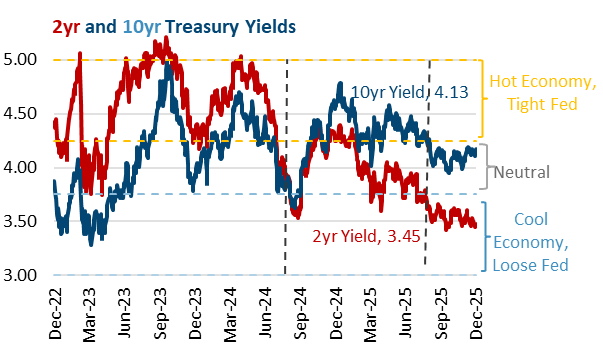
Chart 1
Many observers may simply assume that if the Fed is planning to cut rates again in 2026, then long-term rates are automatically headed lower. Yet when the Fed commenced rate cuts in September of 2024 and 2025, in both cases, long-term rates rose from the first cut through year end.
The model offers insight into why long-term rates could move up, not down, even as the Fed makes short-term rate cuts. If the market is at first concerned about a weaker economy resulting in lower GDP growth or inflation, that 2% + 2% = 4% sum could become 2% + 1%, and a 3% 10yr can beckon. But once the Fed commences its rate cuts, the market looks ahead to the eventual boost, and the market math shifts to 2% + 3% = 5%. This illustrates how the Fed lowering rates on the short end can push the 10yr higher. Thus, an ongoing decline in long-term interest rates could be a challenge, even as the Fed is expected to make additional rate cuts in 2026.
The Agg started 2025 with a yield of 4.9% at the start of 2025 and, thanks to a duration of 6.5, the 50 bps decline in rates in 2025 allowed the Agg to out return its income with a 7.3% overall return. Now, as of 12/31/25, the yield on the Agg is down to 4.3% and interest rates could be hard pressed to fall significantly below 4%, suggesting there is less room for duration to contribute to total return. With interest rates at levels that are generally in line with the economic backdrop, a reasonable return outlook is the current yield of 4% plus or minus 3%, or 1 to 7%. But it is notable that 2025’s 7% is at the top of this 1% to 7% range, which would suggest that 2026 matching 2025’s bond return could be a challenge. And while markets are reflecting a decent base case, the 4% income return could be periodically overwhelmed by price changes from duration, as a 50 bps move in rates can create a price change of 3%. If interest rate volatility picks up, can Fixed Income Earn Its Coupon in 2026?
See Also
Important Disclosures:
Past performance is not indicative of future results. Different types of investments involve varying degrees of risk. Therefore, there can be no assurance that the future performance of any specific investment or investment strategy (including the investments and/or investment strategies recommended and/or undertaken by Grimes & Company Wealth Management, LLC [“Grimes”]), or any non-investment related content, made reference to directly or indirectly in this blog will be profitable, equal any corresponding indicated historical performance level(s), be suitable for your portfolio or individual situation, or prove successful. Due to various factors, including changing market conditions and/or applicable laws, the content in this blog may no longer be reflective of current opinions or positions. Moreover, you should not assume that any discussion or information contained in this blog serves as the receipt of, or as a substitute for, personalized investment advice from Grimes. To the extent that a reader has any questions regarding the applicability of any specific issue discussed above to his/her individual situation, he/she is encouraged to consult with the professional advisor of his/her choosing. No amount of prior experience or success should be construed that a certain level of results or satisfaction will be achieved if Grimes is engaged, or continues to be engaged, to provide investment advisory services. Grimes is not a law firm and does not provide legal advice. Grimes is not a certified public accounting firm. Grimes is affiliated with S&C Tax Advisors, which provides tax preparation and related tax services. Tax services provided by S&C Tax Advisors are separate and distinct from the investment advisory services provided by Grimes and are subject to a separate engagement. Clients are under no obligation to engage S&C Tax Advisors and may obtain tax preparation or other tax services from any provider of their choosing. Information provided by Grimes regarding tax matters in connection with its investment advisory services should not be construed as individualized tax advice or a substitute for services provided by a qualified tax professional. Grimes is not an insurance agent. Grimes Representatives may, however, separately provide insurance products and services through our affiliate, Grimes Wealth Protection Group, LLC. If the client desires, one of Grimes’ representatives, acting in their capacity as a representative of Grimes Wealth Protection Group, LLC or in their separate licensed individual capacities, can be engaged to provide insurance sales/services as described on Grimes’ written disclosure Brochure per the terms and conditions of a separate engagement. Grimes is affiliated with Grimes Trust Services, a corporate trustee that offers trustee services under a separate engagement. Clients are under no obligation to retain Grimes Trust Services for trustee services. Any information provided by Grimes regarding trust matters in connection with its investment advisory services should not constitute trustee services and be considered a substitute for services provided by a qualified professional. Nothing contained herein should be construed as the receipt of, or a substitute for, personalized investment advice from Grimes. A copy of our current written disclosure Brochure discussing our advisory services and fees is available for review upon request or athttps://www.grimesco.com/form-crs-adv/ Please Note: Grimes does not make any representations or warranties as to the accuracy, timeliness, suitability, completeness, or relevance of any information prepared by any unaffiliated third party, whether linked to Grimes’ web site or blog or incorporated herein, and takes no responsibility for any such content. All such information is provided solely for convenience purposes only and all users thereof should be guided accordingly. Please Remember: If you are a Grimes client, please contact Grimes, in writing, if there are any changes in your personal/financial situation or investment objectives for the purpose of reviewing/evaluating/revising our previous recommendations and/or services, or if you would like to impose, add, or to modify any reasonable restrictions to our investment advisory services. Unless, and until, you notify us, in writing, to the contrary, we shall continue to provide services as we do currently. Please Also Remember to advise us if you have not been receiving account statements (at least quarterly) from the account custodian.