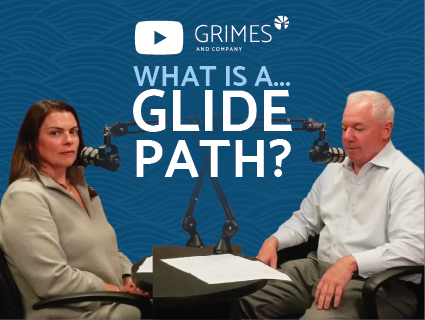


In this video, Grimes & Company’s Head of Financial Planning Emily Wood sits down with Portfolio Manager Chris Deeley to unpack the concept of a “glide path” and what it means to slowly reduce risk on the path to retirement, and why it is not a one-size-fits-all approach. They also touch upon the need to be flexible with your glide path to ensure a smooth transition to retirement.
Watch the video below:
Watch Other Videos in this Series
- Inflation & Retirement
- The Power of Compound Interest
- Maximize Your Retirement Plans: 401(k), IRA, HSA
Video Transcription:
Emily: Hi, I’m Emily Wood. I’m the head of financial planning here at Grimes and Company. And I’m with my colleague, Chris Deeley, who’s one of our portfolio managers here. And today we wanted to talk a little bit about glide paths.
Chris: What a glide path is is as you’re investing your portfolio and you get closer to retirement, you’re gradually adjusting your risk tolerance by conservatively positioning the portfolio over time to reduce the risk in the portfolio.
Emily: Chris, when you say reduce the risk, can you talk a little bit about what do you mean by reducing portfolio risk specifically?
Chris: Sure. So when you think about when you’re investing early on in your career, in your 20s and 30s, you certainly want to be more aggressive and have more equities in the portfolio. As you get older, you want to become more conservative based on if there’s dislocation in the market and you get closer to retirement age, you want to make sure you’re not having a huge drawdown in your portfolio before you need the income You’re going to add more bonds over time, which are much more of a conservative instrument than equities. So you’re basically moving stocks to bonds over a long period of time, very, very gradually.
Emily: It’s funny, because when clients retire, we’ll often hear them ask, can you put me in my retirement portfolio? And I think there’s this concept that once you’ve retired, you should have a portfolio that’s primarily there to produce income. But the reality is, if you’re retiring in your mid to late 60s, you have another 25 plus years from which to draw from the portfolio. So there is still that need for some risk in the portfolio. And the thought really is just, how much and what’s appropriate? And also, I think, what’s going on in the market at that time, right? Because you need to look not just at how you feel your portfolio should be positioned, but what’s the market offering you at that point in time?
Chris: Yeah, that’s a perfect example of I just had a client conversation the other day with a 52-year-old. His retirement account has been in all stocks. So it doesn’t mean that just because you’re in your 50s, you have to have bonds. And we’ve looked at it every year. And where interest rates had been for the last 10 years, he just wasn’t comfortable owning bonds until this year where he said, you know, rates are more normal. Let’s put a bond allocation in there and lower the volatility in the portfolio. So when Emily and I are talking about the market, it’s really when there’s big dislocations in the market and whether the bond market is really dislocated or the stock market is really dislocated.
Emily: Yeah, absolutely. think you want to talk a little bit about the global financial crisis. That was a very significant dislocation and by early 2009, if anything, that was probably a really great buying opportunity. And so again, you don’t want to be on this regimented path where you say, I must do this, and it might cause you to overlook opportunities like that.
Chris: There’s no one path that is the most successful, but it’s always just looking forward and making sure that for what your needs are, we’re continuing to look at that and gradually reduce risk over time if needed.
Emily: And as much as a glide path can help kind of smooth your journey into retirement, there are some things to consider. There can be some pitfalls. Do you want to touch on those a little bit, Chris?
Chris: Don’t get too conservative too early because you do need to grow your portfolio and you do outgrow inflation. also have to look at, don’t try and market time the portfolio. We know it’s very difficult to time the market, especially when you’re looking at your retirement assets. Be savvy, talk to your financial advisor, make sure you’re looking at your glide path annually. And if there’s unexpected events in your life, whether it’s a health issue or a job change, you’re making more money, you’re making less money, those can all factor into how your portfolio is positioned for the long term.
Emily: Absolutely. So maintaining flexibility, maintaining communication with your advisor, those things are key. Those are all things that will help keep you on track no matter what the end goal is.
Chris: Yes, and I think a well-planned glide path helps you land retirement very smoothly.
Emily: Absolutely. Well said, Chris. Again, my name is Emily Wood. I’m with my colleague Chris Deeley. We’re at Grimes and Company. If you want to learn more, you can go to grimesco.com. Thanks.
Important Disclosures:
This presentation is intended for general information purposes only. No portion of the presentation serves as the receipt of, or as a substitute for, personalized investment advice from Grimes & Company Wealth Management, LLC (d/b/a Grimes & Company) (“Grimes”) or any other investment professional of your choosing. Different types of investments involve varying degrees of risk, and it should not be assumed that future performance of any specific investment or investment strategy, or any non-investment related or planning services, discussion or content, will be profitable, be suitable for your portfolio or individual situation, or prove successful. Neither Grimes’ investment adviser registration status, nor any amount of prior experience or success, should be construed that a certain level of results or satisfaction will be achieved if Grimes is engaged, or continues to be engaged, to provide investment advisory services. Grimes is neither a law firm nor accounting firm, and no portion of its services should be construed as legal or accounting advice. No portion of the video content should be construed by a client or prospective client as a guarantee that he/she will experience a certain level of results if Grimes is engaged, or continues to be engaged, to provide investment advisory services. Copies of Grimes’ current written disclosure Brochure and Form CRS discussing our advisory services and fees are available upon request or at www.grimesco.com.