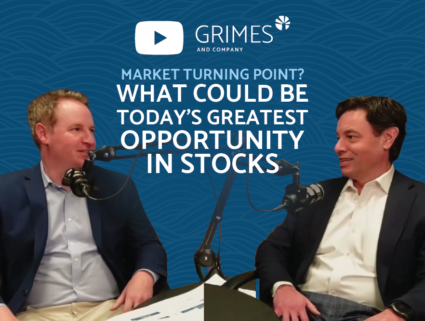

Markets often look calm on the surface—but underneath, leadership can shift in meaningful ways. In this video, Grimes & Company CEO Kevin Grimes and Matt Morse, Chief Equity Strategist, discuss why the market may be at an inflection point. While the S&P 500 has been relatively flat in recent months, a narrow group of mega-cap stocks has driven much of its performance, leaving other areas of the market behind.
Kevin and Matt explain what this could mean for investors, including the historical pattern of quality companies outperforming over full market cycles. They share how Grimes & Company defines “quality” and why the current environment may present a compelling opportunity for long-term, quality-focused investors. Watch the full video below for their insights.
Video Transcription:
Kevin Grimes:
Quality, in our opinion, is the single most important factor for investing in stocks. And quality outperforms the market two-thirds of the time.
Matt Morse:
I’m Matt Morse, the head of equities for Grimes and Company. I oversee our equity team and equity process and manage three of our foundational equity portfolios and strategies, and we’re here today to talk to you about what we’re seeing as a potentially significant leadership change in the market that’s been unfolding over the past three or four months, something we’re really excited about.
We’ve seen some some dramatic shifts from, say, speculative pockets of the market into higher quality companies and see real opportunities there.
So, I’m here with Kevin Grimes, the CEO and CIO of Grimes & Company. Kevin, since about October, the S&P 500 is roughly flat, but I feel like that really doesn’t capture the story of what’s happening in the market over the past three or four months. What’s really happening in the markets?
Kevin Grimes:
Well, there’s a lot. The goal of this presentation here is just to talk about how we could be at an inflection point in the markets. We could be at one of those historical turning points where leadership changes, market dynamics change a little bit. We’re starting to see a little bit of evidence of that so far.
So just to set the stage a little bit, if you look at a chart of the rolling return differential between the S&P 500 and the equal weight S&P 500, it tells a really interesting story.
The S&P 500, that’s the index we all know and love, we’re trained to follow as young investors, it’s everyone’s benchmark. The S&P 500, the way it’s built is that the larger companies represent a bigger portion of that index. And so if you think about it, if you go through periods where the biggest companies continue to outperform, then you’re left in a situation where a larger and larger portion of that index is represented by fewer and fewer companies.
So for example, if you look at where we are today, the top seven to ten companies represent over 40% of the return of the index— 40% of the weighting in the index.
The equal weight index, It’s the same five hundred companies. It just that takes all five hundred companies and weights them exactly the same in the index, so that they all have an equal contribution to the return of the index. And so if you think about these five hundred companies, each of those five hundred companies represents 0.2% of the index, so it’s it’s the same stocks, just weighted completely differently.
And if you look at the return differential between the two indices, the cap weighted, the traditional S&P 500, has outperformed the equal weight 500 by the largest margin since the tech bubble back in 1998, 1999.
So, I’m not saying that we’re in a bubble. I’m not saying that we’re going to have a three year bear market like we did after the tech bubble in the early 2000s. A lot went on back then. But what I am saying is that when things get out of whack by historical standards, you tend to see a mean reversion. You tend to see things go back to a more normal environment.
Look, those biggest companies in the S&P 500, they’re some of the best companies in the world. You’re talking about your Googles, and Amazon, and Apple, Microsoft. I mean, these are really important companies. These are also the companies that are the AI hyperscalers. Collectively, they’re putting hundreds of billions of dollars into AI build out. And so, there’s been a lot of excitement about AI. The rest of the markets kind of been left behind.
I think what we’re starting to see now is a little shift, and that shift can last a while. And so, Matt, when I look, I was just looking this morning, to your point, you know, the S&P is flat over a long period of time, but a lot’s going on under the hood, right?
So if I look at them the MAG 7, the magnificent seven stocks, they’re really driving the S&P 500, or have driven the S&P 500, they’re down about 5% year-to-date. Here we are through the middle of February. If I look at the S&P 500, the traditional headline cap weighted S&P 500, it’s down about 1%. If I look at the equal weight S&P 500, it’s up 6% for the year. So we’re already seeing a substantial shift in the market where other indices and other sectors are starting to lead.
These are some of the best companies in the world that have driven the market higher. We’re not expecting a bear market for these companies necessarily. What we’re simply thinking is perhaps, as far as leadership in the S&P, they might be handing the baton off to some of the other sectors. And we’re seeing this other phenomenon where it’s impacting our stock strategies is in the quality realm. And we really focus on quality companies.
So Matt, I’m going to throw it back to you. You are the lead portfolio manager on our equity strategies. Equity meaning our individual stock strategies. When I say we focus on quality and quality companies, how would you define that and how would you explain what that means to the audience?
Matt Morse:
Sure. Yeah, everyone has a different definition of quality. Our definition is really investing in good businesses in solid industries where we think they can grow their free cash flow at an above average rate that’s not appreciated by the market or reflected in valuation.
We also firmly believe that returns on invested capital are really what drive long-term equity outperformance, and also, you know, prudent balance sheets. Some companies can operate with a certain degree of leverage, some cannot. So we really think about it as prudently managed balance sheets and capital allocations.
And really the reason we care about quality, and it permeates really everything we do is that, you know, historically high quality companies have proven to be the path to the highest risk adjusted returns across market cycles, really because of those characteristics I just mentioned, as opposed to, say, trying to chase fads in the market and catch maybe the next thing, versus focusing on businesses that are durable leaders that can continue to compound at those higher rates of return and higher free cash flow and return some of that cash flow over time.
Another thing to mention about quality is similar to what you were sharing. 2025, kind of mid-year through year-end quality stocks, underperformed the S&P 500 by their widest margin also since 1999, interestingly, and following that prior period, all the way back in 99, quality stocks went on to outperform the S&P by over 2% per year for the next 25 years or so.
So, I think it’s interesting that both the equal weighted portion of the market, small cap stocks, but then also the quality cohort basically have these historic discrepancies in performance relative to the S&P to the extent that we haven’t seen since the late 90s.
And another interesting point, kind of tying it together there, is that from, call it mid-year last year through year end, unprofitable stocks, certain micro caps, or unprofitable companies in the market actually outperformed quality stocks by their widest margin in history of over about 20%.
So we’ve really seen, although it’s been sort of a quiet market the last three or four months and a generally good period for the S&P the last three plus years, we’ve seen some real extremes here and oftentimes extremes like this create great opportunities, which is really what we see here today, particularly in quality stocks and other pockets of the market that have, you know, been left behind the last three years or so.
Kevin Grimes:
Yeah, and now so, would you say that unprofitable companies when you see periods where they actually have these these surges of out performance, it’s probably from, maybe, over enthusiasm about some themes? Like, I mean, AI is an incredible theme, but when you see these euphoric periods, would you say it’s from over enthusiasm in the markets? You think maybe it’s a hallmark of risk taking behavior that occurs at times?
Matt Morse:
Yeah, it’s a very important question. When we look at things historically going back three or four decades, quality stocks, which we’ve talked a bit about, have outperformed about two-thirds of the time over all quarters going back 40 years.
This sort of lower quality speculative cohort that we’re talking about, profitless stocks, have typically outperformed about a third of the time. So two-thirds quality outperforms, a third speculative unprofitable outperforms.
Clearly in the last 12 months we’ve been in that one third pocket. But what we ultimately see, and why I think there’s that persistence of quality outperformance, is that ultimately, businesses are worth the present value of the cash flows they are going to generate in the future. And for businesses that don’t have cash flows, there’s no anchor to winward with valuation, right?
Kevin Grimes:
Just to take it across the bridge. Quality, in our opinion, is the single most important factor for investing in stocks. And quality outperforms the market two-thirds of the time.
It just underperformed to its greatest extent in a quarter century last year. Seems to me like right now is a historically good time to be investing in a quality stock portfolio. We could be at the beginning of a 12 to 24 month period of strong outperformance. Now, let’s see what the market brings, but we just want to make sure that investors know what the opportunity is in the markets right now.
Matt Morse:
Really well said. These opportunities don’t come around all the time where you see, you know, anomalies in the market that you haven’t seen for twenty five years. So, exciting time for us as quality investors, and if you have any questions, once again I’m Matt Morse, Head of Equities at Grimes & Co, please feel free to reach out or contact us on our website grimesco.com
Important Disclosures:
This presentation is intended for general information purposes only. No portion of the presentation serves as the receipt of, or as a substitute for, personalized investment advice from Grimes & Company Wealth Management, LLC (d/b/a Grimes & Company) (“Grimes”) or any other investment professional of your choosing. Different types of investments involve varying degrees of risk, and it should not be assumed that future performance of any specific investment or investment strategy, or any non-investment related or planning services, discussion or content, will be profitable, be suitable for your portfolio or individual situation, or prove successful. Neither Grimes’ investment adviser registration status, nor any amount of prior experience or success, should be construed that a certain level of results or satisfaction will be achieved if Grimes is engaged, or continues to be engaged, to provide investment advisory services. Grimes is neither a law firm nor accounting firm, and no portion of its services should be construed as legal or accounting advice. No portion of the video content should be construed by a client or prospective client as a guarantee that he/she will experience a certain level of results if Grimes is engaged, or continues to be engaged, to provide investment advisory services. Copies of Grimes’ current written disclosure Brochure and Form CRS discussing our advisory services and fees are available upon request or at www.grimesco.com.